Release Date: February 3, 2015Technology in the 20th century made unprecedented leaps. Humans went from being unable to fly in early 1903 to landing on the moon less than 70 years later. Minor cuts and scrapes could become life-threatening if they became infected and then we discovered antibiotics and a range of new surgeries became available. We discovered bombs that could single-handedly both destroy and power entire cities.
Publisher: Signet
Age Group: Adult
Source: Purchased
Pages: 528
Buy: Amazon | Barnes & Noble |
IndieBound | Book Depository
Description: Goodreads
Physicist Jon Grady and his team have discovered a device that can reflect gravity—a triumph that will revolutionize the field of physics and change the future. But instead of acclaim, Grady’s lab is locked down by a covert organization known as the Bureau of Technology Control.
The bureau’s mission: suppress the truth of sudden technological progress and prevent the social upheaval it would trigger. Because the future is already here. And it’s rewards are only for a select few.
When Grady refuses to join the BTC, he’s thrown into a nightmarish high-tech prison housing other doomed rebel intellects. Now, as the only hope to usher humanity out of its artificial dark age, Grady and his fellow prisoners must try to expose the secrets of an unimaginable enemy—one that wields a technological advantage half a century in the making.
Showing posts with label penguin. Show all posts
Friday, February 17, 2017
Influx by Daniel Suarez
Monday, September 26, 2016
A Curious Beginning by Deanna Raybourn or An Open Letter to a Beloved Author
Dear Deanna,
Release Date: July 12, 2016
Check out this gorgeous paperback cover!!!
Publisher: Berkley
Age Group: Adult
Source: Publisher
Series: Veronica Speedwell #1
Pages: 368
Buy: Amazon | Barnes & Noble |
IndieBound | Book Depository
Description: Goodreads
London, 1887. After burying her spinster aunt, orphaned Veronica Speedwell is free to resume her world travels in pursuit of scientific inquiry—and the occasional romantic dalliance. As familiar with hunting butterflies as with fending off admirers, Veronica intends to embark upon the journey of a lifetime.
But fate has other plans when Veronica thwarts her own attempted abduction with the help of an enigmatic German baron, who offers her sanctuary in the care of his friend Stoker, a reclusive and bad-tempered natural historian. But before the baron can reveal what he knows of the plot against her, he is found murdered—leaving Veronica and Stoker on the run from an elusive assailant as wary partners in search of the villainous truth.
How do I love thee? There is not enough room on this blog to count the ways, but that won’t stop me from trying to articulate a few of them here.
- You create strong female characters who are very much in their time while being independent and making their own way in the world with cleverness and poise. Veronica Speedwell is a fully realized woman in the vein of Lady Julia Grey and for this, and all your stouthearted and clever heroines, I thank you.
Thursday, March 5, 2015
The Alex Crow by Andrew Smith
Release Date: March 10, 2015With its insane plot, well-drawn characters, and wholly unique narrative style, Andrew Smith’s Grasshopper Jungle was my favorite novel of 2014. Both Grasshopper Jungle and Winger are rock solid offerings from a delightful, off-kilter author, so my expectations for The Alex Crow were understandably high. Unfortunately, the strengths of both Grasshopper Jungle and Winger are weaknesses in The Alex Crow, which feels like a half-hearted and half-baked Andrew Smith effort.
Publisher: Dutton BFYR
Age Group: Young Adult
Format: ARC
Source: Publisher
Pages: 336
Buy: Amazon / Barnes & Noble / IndieBound
Description: Goodreads
Skillfully blending multiple story strands that transcend time and place, award-winning Grasshopper Jungle author Andrew Smith chronicles the story of Ariel, a refugee who is the sole survivor of an attack on his small village. Now living with an adoptive family in Sunday, West Virginia, Ariel's story is juxtaposed against those of a schizophrenic bomber and the diaries of a failed arctic expedition from the late nineteenth century . . . and a depressed, bionic reincarnated crow.
Thursday, July 17, 2014
Blog Tour: Scan by Sarah Fine
& Walter Jury
Release Date: May 1, 2014
Publisher: Putnam Children's
Buy: Amazon / Barnes & Noble
Tate and his father don’t exactly get along. As Tate sees it, his father has unreasonably high expectations for Tate to be the best—at everything. Tate finally learns what he’s being prepared for when he steals one of his dad’s odd tech inventions and mercenaries ambush his school, killing his father and sending Tate on the run from aliens who look just like humans.
All Tate knows—like how to make weapons out of oranges and lighter fluid—may not be enough to save him as he’s plunged into a secret interspecies conflict that’s been going on for centuries. Aided only by his girlfriend and his estranged mother, with powerful enemies closing in on all sides, Tate races to puzzle out the secret behind his father’s invention and why so many are willing to kill for it.
Walter Jury on his collaboration
with co-author Sarah Fine
Sarah and I work seamlessly together. After I came up with the idea and wrote a very extensive outline, our agents introduced us. We hit it off immediately, and it was clear from her writing and her response to my idea that she would be the perfect partner. It was fun to collaborate on writing this series, specifically working through macro world building and long-range character arcs/journeys. One of the elements that was difficult is the distance of our home locales. Sarah lives in New England and I live in the New York City area, so we started working together long distance—but were able to effectively work out a communication style that assisted each of our needs.
I think I am incredibly deferential to Sarah when it comes to details and minute world-building, whereas I feel like she has great respect for my overarching theme analysis and character arc breakdowns. It's really a fantastic combination and we really were able to take the bull by the horns in every instance where it was necessary to tackle an imminent challenge.
One of the more unforeseen challenges was post-sale to Putnam/Penguin. Our fantastic editor, Stacey Barney, really wanted to work closely to make sure every single mythological question had an answer that was seamlessly integrated. She wanted the story and mythology to be beyond reproach. I think she did a great job in that regard, but the challenge was how do two co-authors who live a large physical distance from one another, work with an editor who wants to take a hands-on approach? That took some logistical planning, but it turned out beautifully and it was a very successful partnership!
About the Authors
Sarah Fine was born on the West Coast, raised in the Midwest, and is now firmly entrenched on the East Coast, where she lives with her husband and two children. She is the author of several young adult books, and when she's not writing, she’s working as a child psychologist.
Walter Jury was born in London and has a background in the film industry. He is a big enthusiast of Jamba Juice’s Protein Berry Workout smoothie, only with soy, never whey.
Friday, February 21, 2014
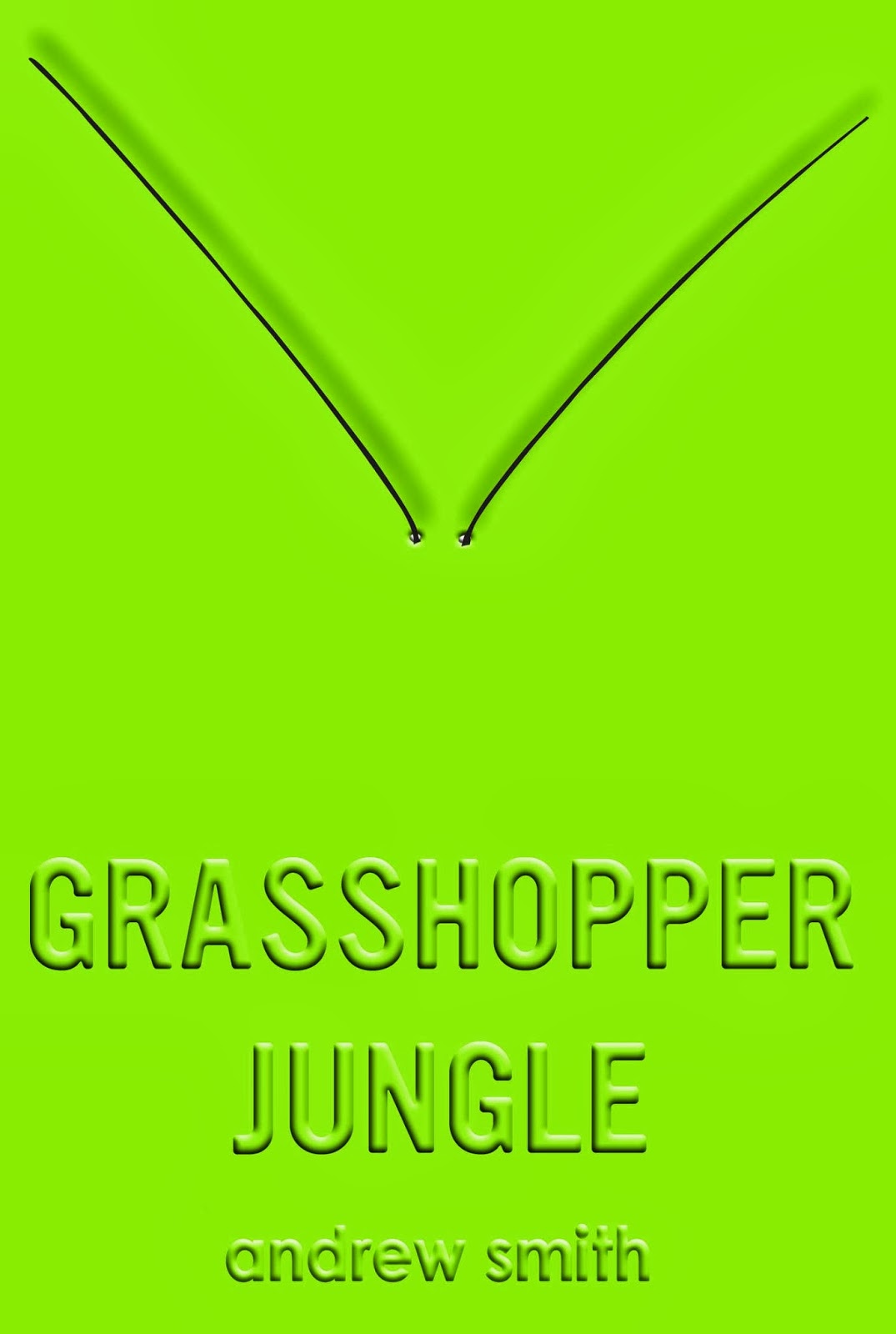
Blog Tour: Grasshopper Jungle
by Andrew Smith
Release Date: Feb. 11, 2014
Publisher: Dutton Juvenile
Age Group: Young Adult
Format: Hardcover
Source: Publisher
Pages: 388
Buy: Amazon / Barnes & Noble / IndieBound
Description: Goodreads
Sixteen-year-old Austin Szerba interweaves the story of his Polish legacy with the story of how he and his best friend , Robby, brought about the end of humanity and the rise of an army of unstoppable, six-foot tall praying mantises in small-town Iowa. To make matters worse, Austin's hormones are totally oblivious; they don't care that the world is in utter chaos: Austin is in love with his girlfriend, Shann, but remains confused about his sexual orientation. He is stewing in a self-professed constant state of maximum horniness, directed at both Robby and Shann.
Ultimately, it is up to Austin to save the world and propagate the species in this sci-fright journey of survival, sex, and the complex realities of the human condition.
About the Author
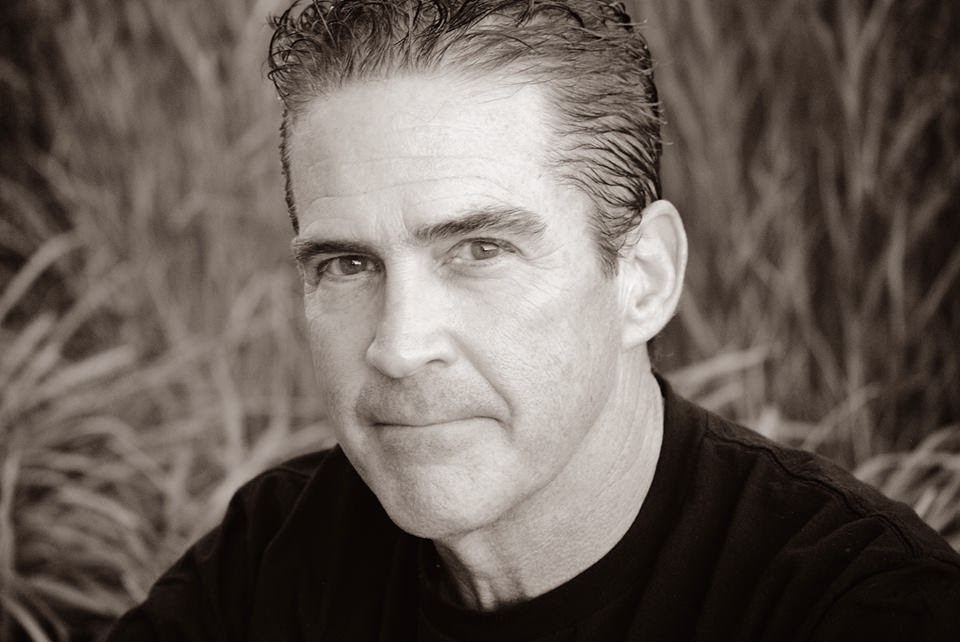
Andrew Smith is the award-winning author of several Young Adult novels, including the critically acclaimed Winger (Starred reviews in Publishers Weekly, Kirkus, Booklist, and Shelf Awareness—an Amazon “Best of the Year”) and The Marbury Lens (A YALSA BFYA, and Starred reviews and Best of the Year in both Publishers Weekly and Booklist).
He is a native-born Californian who spent most of his formative years traveling the world. His university studies focused on Political Science, Journalism, and Literature. He has published numerous short stories and articles. Grasshopper Jungle, coming February 11, 2014, is his seventh novel. He lives in Southern California.
Find him online...
Grasshopper Jungle reads like a text version of the television show 24 on steroids. For those who never watched the show, the picture would frequently split the screen into 2 - 4 panels and show different scenes concurrently. Grasshopper Jungle obtains the same effect by rattling off a series of one-to-two short sentence updates on what every character is doing as it tries to create a snapshot of the goings on in a small town in Iowa. The technique is often used to highlight the complete absurdity of the current situation, spouting series similar to, “Character A was buying cigarettes. Character 2 was trying to find a skateboard. Character 3 was being eaten by a giant grasshopper.” The trick would be cool enough if it stopped there, but narrator often includes reminders of past events in these snapshots, as if he’s trying to compress all of the important events in the novel into one paragraph.
The narrator constantly employs callbacks and epithets to help highlight the bizarre turns of events. For the majority of the novel, these repeated phrases serve as an entertaining way to defuse discussions on serious topics. To continue the television comparisons, the narration often felt like a book version of Arrested Development with its running gags and self-references. Some of the most effective references subvert others, such as, “I was horny and mathematically confused,” adding a twist to the narrator’s constant need to alter the reader to whether he is or is not horny. Eventually, the callbacks do start to wear thin, but not until the last 40-50 pages. Even then, many of the callbacks still work; it’s only the ones persist since the very first chapters that wear out their welcomes.
The novel throws a huge number of balls in the air and manages to juggle most of them extremely well. Off the top of my head, it tackles: premarital sex, absentee fathers, genetic modification, the war in Afghanistan, immigration, child neglect, and sexual confusion. It doesn’t stick the landing perfectly on all of the topics, but it’s still impressively dense thematically while also just telling a fun sci-fi yarn. The main conflict of the novel, giant bugs aside, is the main character’s sexual confusion, the resolution of which is particularly well handled.
It’s interesting to note that the main characters, by and large, have no interaction with the sci-fi plot. They are affected by it and learn of it, but aside from a couple of scenes, the two stories don’t intersect until the novel’s resolution. For most of the novel, the characters are wholly unaware of the exciting sci-fi action. No other sci-fi story comes to mind immediately in which the characters are almost entirely unaware and uninvolved, and it didn’t even realize it was the case until I sat down to write this review.
In closing, the best way I can think to describe Grasshopper Jungle is that it’s wholly original. It has a distinct voice and its attempts to super-compress the entirely of the novel into very few sentences is a really cool trick. I also appreciate how much it jams into fewer than 400 pages. Sometimes it feels like everything these days is the start of a new series and it’s refreshing to run across something that tells a single, self-contained story with more depth than most of those series have in their entire length. While not everything about Grasshopper Jungle works, it comes very close. Besides, it’s much more intriguing to read something unique that’s a bit rough around the edges than it is to read something entirely conventional done to perfection.
a Rafflecopter giveaway
Thursday, January 9, 2014
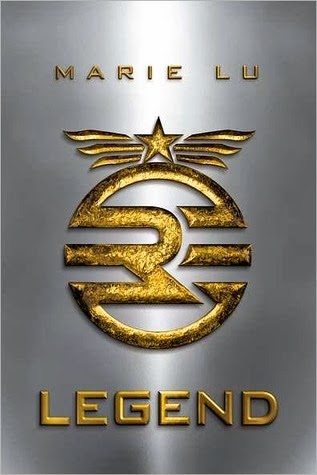
DNF Review: Legend by Marie Lu
Release Date: Nov. 29, 2011
Publisher: Putnam Publishing Group
Age Group: Young Adult
Format: E-book
Source: Purchased
Pages: 234
Buy: Amazon / Barnes & Noble / IndieBound
Description: Goodreads
What was once the western United States is now home to the Republic, a nation perpetually at war with its neighbors. Born into an elite family in one of the Republic's wealthiest districts, fifteen-year-old June is a prodigy being groomed for success in the Republic's highest military circles. Born into the slums, fifteen-year-old Day is the country's most wanted criminal. But his motives may not be as malicious as they seem. From very different worlds, June and Day have no reason to cross paths - until the day June's brother, Metias, is murdered and Day becomes the prime suspect. Caught in the ultimate game of cat and mouse, Day is in a race for his family's survival, while June seeks to avenge Metias's death. But in a shocking turn of events, the two uncover the truth of what has really brought them together, and the sinister lengths their country will go to keep its secrets.
Full of nonstop action, suspense, and romance, this novel is sure to move readers as much as it thrills.
Happy New Year, Wastepaper Prose faithful. I hope your holidays were wonderful and you’re getting back in the swing of regular life. My New Year’s Resolution is to not drop off the face of the blogging earth for four (five?) months this year. With the teary-eyed reunion out of the way, let’s move on to Legend.
This novel marks the first time I’ve started a book for Wastepaper Prose that I just could not finish. While the novel isn’t without its merits, it has a few glaring issues that cause it to commit the cardinal sin: I never once cared about the characters or what happened to them.
All of the novel’s problems boil down to its flagrant violation of the “Show, Don’t Tell” rule. The problem with Day is that we are told that this washout is the most effective and badass freedom fighter/terrorist around. We’re told about these daring, impossible raids that’s he’s completed, often with just a sentence devoted to them. Then, when we finally see him in action, he is almost killed due to an awful, impulsive plan (though even calling it a “plan” seems generous) that I can’t for a second believe was dreamt up by the same guy we’ve heard about for the previous 40 pages.
The exploits we’re told about require intricate planning, patience, and and understanding of risk versus reward. All we see is a panicked kid whose only savings grace is a bunch of soldiers who make Stormtroopers look like deadeyes. He’s also doing all of this, apparently, for his family, who I think actually had lines in one scene in the half of the book I read. But we’re told they’re really good people and Day cares, so apparently we’re expected to, also.
June’s issues are just as problematic. We meet her for the first time after she’s done something reckless. Again, we’re told about her boredom, reckless streak, and genius (another infuriating choice: wading through three paragraphs about the various Trial scores when just saying June is the only one to get a perfect score would suffice). While meeting June during her building climbing incident would have been exciting, we just see her get scolded for it, which is not. However, the real problem with June is her relationship with her brother.
We get a generous two scenes of them interacting, but seeing her brother smile once and being told about that time he fed her an orange doesn’t make me care about him, believe he’s a great brother, or even buy into their relationship. Then I’m asked to care and feel June’s pain when he dies. If I didn’t believe in their relationship, how am I supposed to believe in or care about her grief?
While I wasn’t emotionally invested in the book, parts of the plot showed promise. I finally had enough when the two leads started, predictably, worrying about whether or not to kiss, but despite some cliche plot points, there seemed to be a few interesting mysteries developing. The additions of new plot points or mysteries were paced well and the few action scenes I read were rather exciting.
The book feels like it should be a sequel. There’s a lot of backstory and world building that should have been done prior to the first scene. A prequel would’ve let the world, the characters, and their relationships unfold believably. I’d be invested. The few scenes of the novel where I didn’t feel like I was just wading through paragraph after paragraph of exposition were well done. I believe the author could have told the story well if it had been set up properly. Instead of being shown a believable world, I was just told how things are and expected to care. Unfortunately, I didn’t.
Monday, November 11, 2013
Blythewood Blog Tour:
Guest Post from Carol Goodman
Blythewood
by Carol Goodman
Release Date: Oct. 8, 2013
Publisher: Viking Juvenile
At seventeen, Ava Hall is already orphaned and working at the Triangle Shirtwaist Factory when her life is turned upside down by the horrific fire that kills her best friend and leaves her questioning her sanity. After a summer locked away in a mental institution, Ava is sent to Blythewood, the boarding school where Ava's mother spent the happiest years of her life. But Blythewood is no ordinary finishing school for young ladies: it's a training ground for magical warriors who form the mortal world's only line of defense against the evil world of Faerie.
As Ava develops her own powers, she seeks to solve the many mysteries in her life: Who was the handsome young man who helped save her from the fire-- and why does she remember him having wings? Why did her mother commit suicide? Who is the sinister stranger who's been following her from the city, and what's his connection with the deaths and disappearances that are plaguing Blythewood? When evil broadens its scope beyond the Blythewood campus to impact world events, Ava must decide whom to align herself with, and figure out how to stop the dark forces, even if that means going against everything she’s been taught.
Set in New York's Hudson Valley in the early 1900s, the gothic Blythewood Trilogy vividly portrays a world-- both real and imagined--on the brink of change, and one girl's quest for the truth about her world, her school, and herself.
Carol's Blythewood Guest Post:
In Blythewood, Ava is a girl without a home. The book begins right after her mother has died, and the first third of it has her constantly displaced and moved around until she settles in at the school. The only problem is that she feels like she doesn’t belong there either. It’s not the magic that makes her uncomfortable, because all of the girls are adjusting to that together, but what’s hard for Ava is how different her background is. It’s hard for her to adjust to the values of this super-elite and moneyed society, especially when she doesn’t always morally agree with them.
What makes Ava really special when compared to other YA female protagonists is how sensitive she is. I think there are a lot of really awesome action-hero girls who are coming up in YA — especially in the realm of sci-fi/fantasy YA — and while I love to read about those girls, I could never write them well. Ava loves to drink hot chocolate with her friends and curl up in her castle, and when the time comes to fight, she can, but it’s a very different type of fighting. She isn’t brutal, and prefers to think her way out of problems than go hand-to-hand.

Bestselling author Carol Goodman’s books have been nominated for the IMPAC award twice, the Simon & Schuster/Mary Higgins Clark award, and the Nero Wolfe Award. Her second novel, The Seduction of Water, won the Hammett Prize in 2003.
Find Carol online...
Tuesday, October 8, 2013
The 5th Wave by Rick Yancey
Release Date: May 7, 2013
Publisher: Amulet Books
Age Group: Putnam Juvenile
Format: ARC
Source: Publisher
Pages: 457
Buy: Amazon / Barnes & Noble / IndieBound
Description: Goodreads
After the 1st wave, only darkness remains. After the 2nd, only the lucky escape. And after the 3rd, only the unlucky survive. After the 4th wave, only one rule applies: trust no one.
Now, it’s the dawn of the 5th wave, and on a lonely stretch of highway, Cassie runs from Them. The beings who only look human, who roam the countryside killing anyone they see. Who have scattered Earth’s last survivors. To stay alone is to stay alive, Cassie believes, until she meets Evan Walker. Beguiling and mysterious, Evan Walker may be Cassie’s only hope for rescuing her brother—or even saving herself. But Cassie must choose: between trust and despair, between defiance and surrender, between life and death. To give up or to get up.
The 5th Wave and I started off on the wrong foot. I first heart about it at BEA 2013, when it was recommended to me by Emily of Emily’s Reading Room. Even better, the author was doing a signing, so I could get it for free. That’s what we call “epic win,” kids. Emily and I had it all planned out: a meeting place, a general time, and a detailed strategy for hopping in line. I arrived at the meeting place at the designated time. No Emily. The signing started and still no Emily. I waited for Emily. Apparently, she saw the line while on the way, panicked, and hopped into line. In the end, the mix-up resulted in an amusing story. Little did I know that it would also be a microcosm for my time with the book, which is a somewhat amusing story that starts off poorly and has a few serious issues.
Let’s start with the book’s strength: the alien plot. At least up until the titular fifth wave, the alien plan is rather clever. I especially enjoyed how the plan proceeded through well thought-out stages. Too many alien stories are content to have the alien plot consist solely of shooting giant space lasers at Earth. In The 5th Wave, each stage a solid tactic by itself and is enhanced by the stages that came before it. Yancey could have easily gotten away with making any single stage the entirety of the aliens’ plot and had a perfectly competent alien story, but it was interesting to see so many ideas layered on top of one another.
The character motivations are also well done. The author takes the time to illuminate each character’s reason for not just giving up, but actually running towards the fire, and they’re all believable motivations. While all of their reasons are convincing and realistic, the character voices drove me insane. For one, both characters have a tendency to restate things they’ve just said not a page before, resulting in quite a bit of maddening and pointless repetition. Cassie in particular seems to have a penchant for statements that are supposed to sound deep and original, but almost always elicit a roll of the eyes. The best way I can describe both characters’ voices is as a poor imitation of Buffyspeak.
To be honest, I think the novel would have been better if Cassie for Cassiopeia had been excised entirely. While Ben’s story is somewhat clever, Cassie’s is straightforward and tends to dive into cliche. We’re are almost explicitly told that her only friend is going to end up being an alien. Of course he’s going to fall in love with her, because every action story requires that a forbidden romance be shoehorned in. The romance may have worked had it not felt like a plot point whose sole purpose is to give Cassie a hope of saving her brother. Cassie’s story also makes the details of the 5th wave obvious even before we meet Ben. Without Cassie, we’d be spared a storyline that’s littered with cliches, the twist in Ben’s story would have had devastating impact instead of none at all, and we could have avoided the laughable convenience of our two characters independently deciding to assault the alien stronghold at the same time over a year after the invasion.
I do think there’s a good story buried in the book. The problems are the result of both stories being in the same novel. The shifting perspectives almost always reveal the plot-twists of the opposing story. If the twists actually fostered new and interesting questions about the survivors’ humanity or situations, that we be okay. Unfortunately, there’s none of that to be seen.
Monday, September 30, 2013
Just One Year by Gayle Forman
Release Date: Oct. 10, 2013
Publisher: Dutton Juvenile
Age Group: Young Adult
Format: ARC
Source: Publisher
Pages: 323
Buy: Amazon / Barnes & Noble / IndieBound
Description: Goodreads
The heartrending conclusion—from Willem’s POV—to the romantic duet of novels that began with Allyson’s story in Just One Day
After spending an amazing day and night together in Paris, Just One Year is Willem’s story, picking up where Just One Day ended. His story of their year of quiet longing and near misses is a perfect counterpoint to Allyson’s own as Willem undergoes a transformative journey, questioning his path, finding love, and ultimately, redefining himself.
In my review of Just
One Day, you may remember that I was essentially straight-up in all the
ways dying to read Just One Year like
right now Gayle Forman you give me this book and you put it in my hands omg
WHY. In other more word-like words, I was desperate to know Willem’s side
of things as soon as humanly possible.
By some manner of magic and/or witchcraft, I managed to snag an advance
copy of Just One Year, and I was over
the moon about it! However, I committed
the cardinal sin of reading—in a fever to answer my questions, I skipped to the
end. I KNOW; I am a terrible
person. While I’ll try my best to be NO
SPOILERS about this, my original feeling was, oddly enough,
disappointment. Over the past few
months, I wondered and figured and hypothesized and decided exactly what I
wanted from Willem’s point of view. This
no-context, just-the-destination ending wasn’t the book I wanted.
Thankfully, it ended up being the book I needed instead, and we all know that
is SO much better.
Upon finishing the entire novel, I had this incredible urge
to cry. Or laugh. Possibly both. Together. I felt sated in a way I
didn't think I would be when I began. The journey itself is the important
part, and the destination isn’t nearly the endpoint. Books—or rather,
good books-- teach that in theory, but this duet of stories does that more than
anything else I’ve read before. It is its own double happiness.
It's very nearly overwhelming, so many times over. Gayle Forman is a spectacular storyteller;
she continues to blow me away with each and every novel.
There are many who won’t agree with me, but while I found
him to be an interesting character, Willem de Ruiter wasn’t one of my Book
Boyfriends. He was a little too sure, a
little too sad, a little too… something I couldn’t place. I could see why Allyson was drawn to him,
though. While I read, my previous
feeling still applied, but (obviously) it’s clearly understandable why he is
the way he is. Willem and I both learned
the power of perspective, almost simultaneously. Willem is a runner, all in the name of
keeping his thoughts on the move rather than standing still. We soon discover why Willem wants to travel
to every nook and cranny of the globe, and I can’t say I blame him. However, whenever he stops, he sees Lulu’s
face. He enlists a cast of hilarious
characters to help him on what he thinks is an impossible quest—find Lulu, the
only girl who has stained him. It’s in
the movement and the journey that he discovers what he’s really looking for,
and I wouldn’t dare spoil that for you.
Monday, July 1, 2013
Anna and the French Kiss by Stephanie Perkins

Release Date: December 2, 2010
Publisher: Dutton
Age Group: Young Adult
Format: E-book
Source: Purchased
Pages: 372
Buy: Amazon / Barnes & Noble / IndieBound
Description: Goodreads
Anna is looking forward to her senior year in Atlanta, where she has a great job, a loyal best friend, and a crush on the verge of becoming more. Which is why she is less than thrilled about being shipped off to boarding school in Paris--until she meets Étienne St. Clair. Smart, charming, beautiful, Étienne has it all...including a serious girlfriend.
But in the City of Light, wishes have a way of coming true. Will a year of romantic near-misses end with their long-awaited French kiss?
I am absolutely not the target audience for Anna and the French Kiss. It seems prudent to just start the review with that. The books does what it tries to do very well: It’s a convincing story about high school with a narrator who both acts and sounds like a high school girl. Unfortunately, I’m neither in high school, nor am I a girl (shocking, I know). Listening to or interacting with high schools girls is near the very bottom of my current interests. The novel is sort of like the teenage romance version of The Catcher In The Rye. It does exactly what it sets out to do and I do respect it for that, but that doesn’t mean that I enjoyed reading it.
My biggest criticism of the novel is that very little actually happens to Anna. Lots of stuff happens around her, but aside from a few scenes with St. Claire and her family, Anna is very rarely the cause of or affected by the action. In fact, most of the stuff that happens around her is just briefly mentioned instead of actually shown. For example, there is a subplot in which a character has cancer. At no point do we even meet this character. The character doesn’t even have a name; we only know them because of their relationship to another character. We’re told intermittently how this character is faring, but we have no reason to care. We don’t know what this person is like. We never see this person’s relationship with the character we’re supposed to care about. The entire episode is used as a lazy way to try to make you care, but never gives you a reason to. The book is littered with tell-don’t-show moments like this. Characters fight, make up, have different fights, and break up all in one-to-two sentence tidbits scattered throughout the novel. To be fair, it makes sense that we won’t be privy to all of the gory details, since Anna herself is a bit of an outsider, but that doesn’t make the technique feel less boring and cheap.
Anna’s penchant for just telling us stuff that’s happened instead of actually showing us the scene is doubly disappointing because Perkins is really good when she actually writes a story scene. Her dialogue is well done and generally sounds natural. She’s very good at pacing a scene and Anna’s inner monologue is quite believable. Some of her descriptions of the settings and architecture are impressive. Her illustration of the sweets in a cake shop stands out as particularly well done. During some of the later conversations between Anna and St. Claire, I was surprised to find that Perkins’ descriptions and pacing had me rapidly turning pages despite my caring very little for either of the characters.
It’s unfortunate that I didn’t care for either Anna or St. Claire, because the other characters in the novel have very little depth. Josh matters only because he’s St. Claire’s best friend. Rashimi seems to only be there to have random fights with Josh so certain scenes can be more awkward. Of course, we never see the cause of or resolution to these fights. After the first few chapters, Meredith is relegated to being some vague obstacle to make Anna feel bad about liking St. Claire. The saddest part is that the characters seem like they’d be interesting if Perkins ever gave them something to do.
Some of them have conflicts running in the background that have potential, if only we got to know the characters and see the conflict. Instead, the characters feel like obstacles at best and afterthoughts at worst, only there to try to drum up tension without actually working to earn it. Even a character who is set up as a sort of “big bad” gets one, wholly underwhelming appearance. His entire subplot and all of the talk about him in the novel could have been excised and the novel would have lost nothing important.
It’s a shame that the execution didn’t click with me (although I can see how it would work for some: it really does do a good job of feeling like a high school girl’s diary), because there are some very good insights in here and a few moments that made me legitimately laugh out loud. I found Anna’s realization that home isn’t home because of its physical location, but because of the people there, a particularly good one to spell out. It’s something we all learn eventually, but is a good message to send to the target audience. In fact, Perkins does a pretty good job of making a book about high school seem an awful lot like the first year of college and packing in lots of little morals (mostly just told to the reader) about what that life is like.
With all that in mind, I think the book is fine for what it wants to be. Sadly, what it wants to be isn’t something I’m particularly interested in reading. I didn’t hate the novel; I just didn’t care. By the first time Josh and Rashimi had a fight we didn’t know the cause of, I was yearning for some ridiculous, Nicholas-Sparks-esque twist, like Anna contracting a debilitating disease or the world being overrun by some sort of Unicorn Armageddon. I sort of respect Perkins for instead opting for a mostly typical, realistic, down-to-earth love story, even if I found the result rather uninteresting.
Wednesday, May 29, 2013
Attachments by Rainbow Rowell
Release Date: April 14, 2011
Publisher: Dutton
Age Group: Adult
Format: E-book
Source: Purchased
Pages: 336
Buy: Amazon / Barnes & Noble / Google
Description: Goodreads
Beth and Jennifer know their company monitors their office e-mail. But the women still spend all day sending each other messages, gossiping about their coworkers at the newspaper and baring their personal lives like an open book. Jennifer tells Beth everything she can't seem to tell her husband about her anxieties over starting a family. And Beth tells Jennifer everything, period.
When Lincoln applied to be an Internet security officer, he hardly imagined he'd be sifting through other people's inboxes like some sort of electronic Peeping Tom. Lincoln is supposed to turn people in for misusing company e-mail, but he can't quite bring himself to crack down on Beth and Jennifer. He can't help but be entertained-and captivated- by their stories.
But by the time Lincoln realizes he's falling for Beth, it's way too late for him to ever introduce himself. What would he say to her? "Hi, I'm the guy who reads your e-mail, and also, I love you." After a series of close encounters and missed connections, Lincoln decides it's time to muster the courage to follow his heart . . . even if he can't see exactly where it's leading him.
Written with whip-smart precision and charm, Attachments is a strikingly clever and deeply romantic debut about falling in love with the person who makes you feel like the best version of yourself. Even if it's someone you've never met.
One of the most buzzed about (and completely worth the buzz)
books of the past few months is Rainbow Rowell’s heart-breaking-and-heart-lifting
story of first love, Eleanor & Park. It deserves every bit of exaltation it’s
received. According to very in-depth
research I’ve done (aka looking at my Twitter feed), the immediate reaction
after finishing E&P is
MORE?! Which leads me here, to Rainbow
Rowell’s first book, 2011’s Attachments. Disclosure: this is not YA. However, it’s got enormous crossover appeal
for an older teen looking to branch out to new horizons or the YA-reading adult
who has grown weary of teenage vampires making teenage vampire choices. The best part (to me) is that this is
different from yet similar to E&P
in all the ways that matter.
Lincoln is 28, living with his mother after years and years
of garnering college degrees, and working as the IT guy for a local Omaha
newspaper in the distant past of 1999.
His specific job is reading through and warning the senders of any and
all emails that have been flagged as inappropriate by their system’s
Webfence. In doing this, he comes across
multiple exchanges between copy writer Jennifer and film critic Beth. Their emails are witty, personal, sweet, and
harmless so he doesn’t send them a warning.
Many exchanges later, things start to get a little more
complicated. Attachments is about being yourself, even when it seems like that
is beyond impossible. It’s hilarious and
romantic and nostalgic and deep. It’s
also the most fun I’ve had reading someone else’s emails since Meg Cabot’s The Boy Next Door.
There’s something so compelling about Lincoln, about his
awkwardness and somewhat arrested development, that keep this from edging over
to creepy. Yes, he shouldn’t be reading
Beth and Jennifer’s emails without warning them. Yes, he definitely shouldn’t look forward to
hearing what they have to say. But it’s
so obvious that Lincoln is completely non-threatening (despite his large
stature), and he means well. Lincoln is
still recovering from an age-old broken heart in a way that shows how deeply he
feels things and how important his relationships are to him. His mother takes advantage of that situation
too much for me to ever totally forgive her, but it’s not really my place to
worry about forgiveness.
It’s also quite easy to see why Lincoln falls for Beth just
by her words. The girl is a writer by
trade, but she is equal parts quick, funny, and nerdy. I’d be friends with Beth in a heartbeat. The story flows easily between the emails and
a third person narrative of Lincoln, and Rowell’s writing shines once
again. She can drop a quip that makes
you snort, and two pages later she hits you with phrases worthy of their own
tumblr posts.
I also have lots of personal reasons to love Attachments. 1999 was my last year of high school, my
first year of college. I worked in a
television newsroom, so there were many asides to which I could relate. The quote that goes straight to my heart,
though? “I knowingly got involved with a
guy who plays the tuba.” Yep. Me too,
Jennifer.
Monday, May 6, 2013
Star Cursed by Jessica Spotswood
Release Date: June 18, 2013
Publisher: Putnam Juvenile
Age Group: Young Adult
Format: E-galley
Source: Edelweiss
Series: The Cahill Witch Chronicles #2
Pages: 462
Buy: Amazon / Barnes & Noble / IndieBound
Description: Goodreads
With the Brotherhood persecuting witches like never before, a divided Sisterhood desperately needs Cate to come into her Prophesied powers. And after Cate's friend Sachi is arrested for using magic, a war-thirsty Sister offers to help her find answers—if Cate is willing to endanger everyone she loves.
Cate doesn't want to be a weapon, and she doesn't want to involve her friends and Finn in the Sisterhood's schemes. But when Maura and Tess join the Sisterhood, Maura makes it clear that she'll do whatever it takes to lead the witches to victory. Even if it means sacrifices. Even if it means overthrowing Cate. Even if it means all-out war.
In the highly anticipated sequel to Born Wicked, the Cahill Witch Chronicles continue Cate, Maura and Tess's quest to find love, protect family, and explore their magic against all odds in an alternate history of New England.
Last year’s Born Wicked (see review) was one of my favorite surprises. I knew I wanted to like it based on the fact that it’s written by one of the most genuinely nice people in the business, Jessica Spotswood. However, historical fiction isn’t usually my bag, baby. As you saw from my review, though, Born Wicked is anything but traditional, and I reveled in the feminist themes, the world of witchcraft, and the adorable Finn Belastra. I’ve been dying for its sequel, Star Cursed, since the moment I closed the first book. It should come as no surprise that Star Cursed is a worthy follow-up with an even stronger story, more sisterly drama, and even more romantic delights.
The thing I love best about Star Cursed is that it has its own separate arc within the greater story. Trilogies are so prevalent in YA, and I read a ton of YA, so I’ve found that the dreaded Second Book Syndrome crops up so often. It’s one of my pet peeves, and it can turn me off to a series completely. There is nothing to worry about here. This is not a sluggish drag between a snappy beginning and a climactic finish. Honestly, by the end of the fourth chapter, I’d run through an entire book’s worth of emotions. Thankfully, you get some recovery time after that, but this doesn’t mean the story stops moving.
The alternate world in which Cate lives continues to spin on, and while she has a bit more freedom in the Sisterhood, she’s still just as feisty and stubborn as ever. We get an even closer look at Cate’s relationship with both of her sisters, and it isn’t always pretty. Cate still acts as a maternal figure for youngest Tess, though that becomes tougher and tougher the older Tess gets. Cate and Maura still butt heads like sisters do, but there is a decided shift in the reasoning behind the fights from the first book to this one. There were so many times I wanted to grab Maura’s shoulders and shake her and shout MAURA WHAT IS YOUR DAMAGE. She has so much anger and angst and honey, keep calm and have a cup of tea. Geezy peez.
I’ve had the pleasure of seeing Jess speak at a couple of signings (yay DC writer friends!), and she always finds a way to mention how much she loves writing the kissing scenes. Even if I didn’t already know that, it would be clearly evident after this. If you thought the feather scene from Born Wicked was something? Oh, you ain’t seen nothing yet. If possible, Finn becomes even more adorable. Of course, a happy, adorable couple means you should have your guard up. Le sigh.
Subscribe to:
Posts (Atom)