home           about           reviews           author insight           review policy
Showing posts with label first second. Show all posts

Tuesday, March 11, 2014

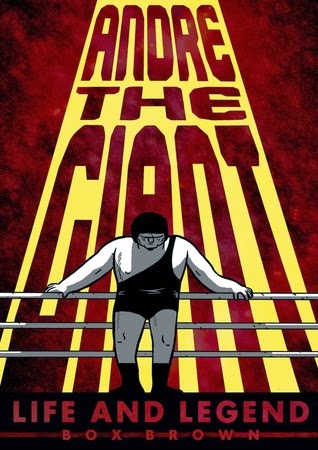
Andre the Giant: Life and
Legend by Box Brown


Release Date: May 6, 2014
Publisher: First Second
Age Group: Young Adult
Format: ARC
Source: Publisher
Pages: 240
Buy: Amazon / Barnes & Noble / IndieBound
Description: Goodreads
Andre Roussimoff is known as both the lovable giant in The Princess Bride and a heroic pro-wrestling figure. He was a normal guy who'd been dealt an extraordinary hand in life. At his peak, he weighed 500 pounds and stood nearly seven and a half feet tall. But the huge stature that made his fame also signed his death warrant.

Box Brown brings his great talents as a cartoonist and biographer to this phenomenal new graphic novel. Drawing from historical records about Andre's life as well as a wealth of anecdotes from his colleagues in the wrestling world, including Hulk Hogan, and his film co-stars (Billy Crystal, Robin Wright, Mandy Patinkin, etc), Brown has created in Andre the Giant, the first substantive biography of one of the twentieth century's most recognizable figures. 

Look, when someone writes a graphic novel biography of Andre The Giant, I have no choice but to read it.  Call it fate or destiny or nerd cred, but it had to be done.  And thank goodness, because Andre the Giant: Life and Legend by Box Brown was a trip worth taking.

Even though I grew up with this gargantuan man in my pop culture lexicon, I still know next to nothing about him except that 1- he wore that one-arm outfit for wrestling that caused my husband & I to refer to all shirts/dresses with one arm as "Andre The Giants," 2- he's hilarious and adorable in the 1987 classic The Princess Bride, and 3- he has a posse.  I can imagine it's pretty much the same for many others of my generation, and I expect it's even worse for anyone younger than me.  He really is a mythical figure for anyone born after his death in 1993.

The novel is touted as a biography, and it certainly is, but it's more of a series of stories told in a linear timeline than a traditional biography.  Box Brown's note at the beginning explains where the stories came from and why they can be taken with a grain of salt.  The drama of wrestling is also explained very well in the author's note, so I wouldn't skip it.  The world of entertainment wrestling has changed so much from the old days, and even though I knew some of these terms by hanging out with wrestling fans, there's even more to the world that never occurred to me.  It only makes Andre's story more interesting.  You can tell Brown is a true wrestling fan; his meticulous words clearly show that.

The graphic novel format is the perfect way to go to tell these stories.  It's one thing to hear Hulk Hogan talk about their "rivalry" or read Billy Crystal's account of a passed out Andre.  It's definitely better to get the visual version, especially for moments like these where there were no cameras rolling.  My favorite panels were of Andre and Terry Funk watching The Princess Bride together and Andre's guffaw at his own "anybody want a peanut?" rhyme.  It adds a level of humanity to this icon in a way little else can.  I just love that.

Brown does a great job of showing you exactly what you need to see without showing you too many details.  It's simple, but it works here. The stories speak for themselves, and the art is here to enhance that.  This is best displayed during the illustrated fights, in which the artwork and Brown’s fight commentary go hand in hand.  Brown takes you on a journey through every side of Andre-- the good, the bad, the occasionally drunk, and the uncomfortably cramped.  I especially liked the full page panels that explained acromegaly, which was why Andre was The Giant.  Within these pages, no panel is wasted.

This is a great book for anyone who's ever heard of Andre Roussimoff, the Eighth Wonder of the World.  Alternately poignant and fun, angry and silly, Andre the Giant: Life and Legend lives up to its name and its subject matter.  You should read it, boss.

Tuesday, February 4, 2014

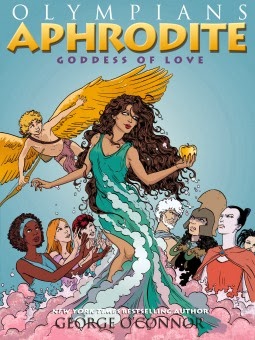
Aphrodite Blog Tour & Guest Post by George O'Connor


We are thrilled to have George O'Connor here today to tell all about the latest installment of his New York Times Best-Selling Olympians series, Aphrodite. The truth is we were going to host him on Sunday, but due to a shift in the space-time continuum (or real world insanity) we are running a little behind. Regardless, he's finally here and we're excited to share he and his work with our readers.


Aphrodite: Goddess of Love
By George O'Connor 

Release Date: Dec. 31, 2013
Publisher: First Second

In volume six of Olympians, graphic novel author/artist George O'Connor turns the spotlight on Aphrodite, the goddess of love. Look for the same thoroughly researched and wonderfully accessible comics storytelling as O'Connor tackles the story of the Aphrodite from her dramatic birth (emerging from sea-foam) to her role in the Trojan War.

O'Connor has outdone himself with this volume: the story is riveting and the artwork is beyond compare. Greek mythology has never been so vivid!


Hey, readers of Wastepaper Prose! My name is George O’Connor, and you’re joining me on day two of my blogcrawl to commemorate the release of my new book, Aphrodite: Goddess of Love. Aphrodite is the sixth volume of my projected 12 volume series of graphic novel retellings of classic Greek myth called Olympians. The good folks at Wastepaper Prose were kind enough to invite me to contribute this guest post, and in keeping with the theme of wastepaper prose, I thought I’d write a little today about the stuff that didn’t make it. The stuff that ended up in the wastepaper basket, so to speak.

One of the most challenging things about writing each volume of Olympians is adhering to the story length I established in the first book, Zeus: King of the Gods. 66 pages of comics, 14 pages of back matter. That means I have to do a lot of distilling, of literally thousands of years worth of stories, down to 66 pages, to present (hopefully) a perfect little snapshot, a gem that encompasses and envelops and conveys completely the underlying idea behind the featured deity, be they Zeus or Athena, Aphrodite or Poseidon.

With a set length as a constant for the series, often times I start writing at the beginning of the book (and by writing, I mean drafting both words and pictures—comics act as a synthesis of words and pictures and I find I need to create both simultaneously) and after a point I shift to the end of the book. With a set beginning and ending, I see how much room I have in the middle to play around in. If I find I need to insert a sequence at the end of the story to underline a point that nails, just really nails the theme of the book, well, it means I’ll probably have to take out something from earlier, like maybe that really fun sequence with the giants that would have been SO FUN to draw but ultimately was a bit of a narrative vestigial tail--interesting to look at perhaps, but not playing any necessary role.

When I began Olympians, I boldly and with a certain lack of hubris, planned for it to be a 12 volume series. To that effect, I created an enormous spreadsheet that detailed which myths would be covered by each individual book in the series, to best illustrate the essential nature of the titular deity. I noted which stories would cross over into which volume, which narrative threads would carry over into other books, etc. As a whole, so far, I’ve adhered very closely to that initial roadmap. There have been a few surprise deviations—In my research, I discovered a sweet little fable that I previously hadn’t known that tied Hera together like a bow; conversely, I had intended to feature the story of Eurydice and Orpheus as a subplot in Hades, but ultimately had to cut it when the central story grew and urgeoned against that dread 66 page limit. Something had to go and Orpheus was it. Sorry buddy, I can’t look back.

With Aphrodite, my wastepaper basket prose was the story of Eros and Psyche. I was at one point quite keen to include at least part of that story in Aphrodite, not the least because a good many fans of the series had written me expressing their hopes to see it Olympians-ized.

Here’s a quick refresher of the basics of the story, for those of you who are not as mythomaniacally inclined as I: Psyche was a mortal princess, whose beauty was often compared to that of Aphrodite herself. Aphrodite is offended by this and orders her son Eros to wreak some romantic havoc on Psyche, but then Eros falls in love with her himself. Through some Beauty and the Beast style trickery, Eros arranges that he marries the mortal princess in secret, and they carry out their relationship literally in the dark, hiding Eros’ true, allegedly monstrous, from Psyche. Psyche eventually becomes worried/curious enough to see her husband’s face, and by torchlight discovers Eros is not a monster but a beautiful god. She accidentally burns him with oil, though and he flees from her back to his mother’s palace. Psyche wanders the world for a time, meeting various Olympian deities who guide her until she finds herself at the palace of Aphrodite. Aphrodite cruelly makes Psyche undergo various tasks to prove herself worthy of Eros, including a trip to the underworld for beauty crème (!). Finally, Eros mans up, leaves his mom, finds Psyche and the two plead their case to Zeus, who says this recap has gone on long enough and the Eros and Psyche get married, Olympus style.

Looking back, it’s obvious why it had to go. Narratively, its casting of Aphrodite as the bad guy didn’t much jibe with my book’s central theme of exploring the Goddess of Love as the outsider married into a family of superhuman lunatics. Her persecution of Psyche is hardly going to win her any sympathy. It was also too long—even my recap was crazy lengthy! It could easily float an entire volume of Olympians all by its lonesome. Were I ever to go totally nuts and expand Olympians past its projected 12 volumes, and visit some of the minor deities of Olympus, it would almost certainly serve as the backbone for a hypothetical Eros book. My initial idea in the outline was to join the story en media res with Psyche on her trip to the Underworld and fill in the rest with what would have to have been a heroic amount of exposition, but man, that was just not going to work.

Finally, the story of Eros and Psyche features a maturing and growing Eros—certainly older than the cherubic troublemaker who eventually flits through Aphrodite, and that young winged hellraiser was ultimately the more fun character. So sorry, Eros and Psyche, this outing was not for you. As I lay it out here, it probably seems obvious to you the reader that it wasn’t going to be, but I’m stubborn, I guess, and had to figure it out myself. I’m happy to report that after I realized the folly of trying to shoehorn in Psyche the rest of Aphrodite came together easily, like the pieces of a puzzle.

I hope you enjoyed reading my guest post on… letting go and letting your story decide where it needs to go. And if some of that story is to be relegated to the wastepaper basket, well, that’s really not so bad a thing.

Friday, August 30, 2013

Guest Review: Battling Boy by Paul Pope


Release Date: Oct. 8, 2013
Publisher: First Second
Age Group: Middle Grade
Format: ARC
Source: Publisher
Series: Battling Boy #1
Pages: 208
Buy: Amazon / Barnes & Noble / IndieBound
Description: Goodreads
The adventure begins in the new graphic novel by comics legend Paul Pope.

Monsters roam through Arcopolis, swallowing children into the horrors of their shadowy underworld. Only one man is a match for them - the genius vigilante Haggard West.

Unfortunately, Haggard West is dead.

Arcopolis is desperate, but when its salvation comes in the form of a twelve-year-old demigod, nobody is more surprised than Battling Boy himself.

IT'S TIME TO MEET AN ELECTRIFYING NEW HERO.

Paul Pope’s art is wonderful, that’s the first thing to realize about Battling Boy. The comic has a very unique visual style that is a treat to the eyes. The organic and craggy, yet flowing artwork that is Pope’s signature comes out full force, in direct contrast to much of the mainstream comic’s super polished and sterile look. The artwork has such personality that it gives each character a kind of visual vitality, lodging in your mind.

The characters are at once recognizable and distinct. Haggard West as Arcopolis’s resident hero fighting the good fight against legions of monsters pulled from mythology and popular culture; Battling Boy’s father, a god or hero who resides on a divine techno Asgard and Battling Boy himself, with his honest expressions and youthful outlook.

In his arsenal, Battling Boy has his traveling cloak and magical t-shirts, each with a different animal that allow him to tap into their knowledge and power; from the T-rex to the field mouse, in addition to his invisible credit card and prepaid apartment.

The setting is a continent spanning urban jungle called Arcopolis, under siege by monsters, the classic setup of a new hero inheriting from the old, and the relationship with local authorities, all of it has a fun twist. The mayor and his cabinet are just as concerned about Battling Boy’s PR as they are about the city’s monster problem, setting up a parade and a float with Miss Teen Arcopolis while Aurora, Haggard West’s daughter, isn’t too keen on her father suddenly being supplanted by some new upstart.

The ideas that make up the story come from established comic conventions to give a basis and structural support for the story but are infused with a sincerity and vigor often absent from modern versions. Battling Boy’s story combines the classic Cambellian “call to adventure” with the origin story of the superhero. Battling Boy is literally just a boy, albeit the son of a god, but his childhood mirrors that of most kids his age and his reluctance to leave home to go live on some alien world is relatable. Thankfully Pope avoids the angst and moping that can be all too common in such a scenario and focuses on the reality. If you were fighting a monster, what would you do? Call Dad! 

The comic subverts the usual narrative of a hero coming into a situation as competent and powerful, what makes it interesting is not that it is a traditional hero story, with the hero just winging it, but that it does not indulge in an ironic or postmodern attitude, becoming a straightforward and earnest take on the idea, which is as refreshing as it is entertaining. 

The story ends on a big cliffhanger as the monsters have struck a decisive blow against Arcopolis; the monsters have figured out Battling Boy’s weakness, Miss Teen Arcopolis has been kidnapped and he has just met up with Aurora. I’m definitely ready for volume 2.

Tuesday, July 17, 2012

Friends with Boys by Faith Erin Hicks


Release Date: Feb. 28, 2012
Publisher: First Second
Age Group: Young Adult
Format: Paperback
Source: Publisher
Pages: 224
Buy: Amazon / Book Depository / IndieBound
Description: Goodreads
A coming-of-age tale with a spooky twist!


Maggie McKay hardly knows what to do with herself. After an idyllic childhood of homeschooling with her mother and rough-housing with her older brothers, it’s time for Maggie to face the outside world, all on her own. But that means facing high school first. And it also means solving the mystery of the melancholy ghost who has silently followed Maggie throughout her entire life. Maybe it even means making a new friend—one who isn’t one of her brothers.


Graphic novels are a medium I’ve been dying to explore for years.  I grew up in a comics-heavy household, but I rarely ever drifted away from the Riverdale gang in Archie comics (in case you’re curious: Betty, duh).  In recent years, I’ve looked to graphic novels to break out of a reading rut, as I found that they have a special way of reigniting my creative side and showing me a whole new way to look at a story. 

So how excited am I about diving into some YA graphic novels?  In a word: extremely.  If they are all standouts like Faith Erin Hicks’ Friends with Boys, then I’m definitely in for a treat.  Friends with Boys is a perfect gateway read into the graphic novel world for someone who’s unfamiliar with or hesitant to read them.  It’s the relatable story of a Grade 9-er named Maggie McKay, chronicling her first time attending public school and all of the literal and figurative ghosts that follow you home.

Maggie is a very real and tangible protagonist.  Even if you haven’t been homeschooled, you can understand her wariness to attend school outside of her kitchen for the first time.  She has more than enough to handle, with her mother being absent, her father getting promoted, and her brothers acting how brothers do, and it endears the reader to her almost from the first panel.  Because of Maggie’s endearing qualities, it’s both enjoyable and adorable to witness Maggie come out of her shell and befriend punky siblings Lucy and Alistair.

And speaking of the Siblings Mohawk, I must state that I pretty much love them both for many different reasons.  Not only did I delight in Lucy’s quirkiness and Alistair’s smooth confidence, I thought their backstory was brilliantly compelling.  Friends with Boys is all about finding the strength to be who you are without apologies, and Lucy and Alistair show that every day.

What drew me to Friends with Boys in the first place, however, was the artwork.  At first glance, it reminded me of the work of Bryan Lee O’Malley (he of Scott Pilgrim fame), which is that realistic yet cartoon-y style.  In short, it was just what I was looking for.  Once I dove in, however, Hicks showed that she has a style all her own—sometimes bubbly and random (I couldn’t stop giggling about the visual depiction of “AWKWARD SILENCE”), others dark and twisty, but always gorgeous.  Certain panels were especially memorable, like Maggie’s exit from the house on her first day, her detailed map of What’s What at Sandford High, and definitely any scene in the graveyard with the strange and somber ghost.  I always feel the best comics are ones where the art and story are perfectly complemented, and that’s certainly the case here.

If you’re looking for something a little left of normal without completely delving into the comics world, I absolutely recommend Friends with Boys.  Hopefully, it will inspire you to look beyond your comfort zone genre and take a chance on something new.  I know I’ll be taking on more graphic novels, and more Faith Erin Hicks novels, in the future.