Our Song by Jordanna Fraiberg Review
2 hours ago
;
"I listen to music before and after I write, but never while I'm writing. My share of Beautiful Creatures was written to my personal soundtrack of: Black Sabbath, AC/DC, The Allman Brothers, Lynard Skynard (lots of Southern rock), the Smiths & the Cure. When I'm actually writing, I need complete silence because I hear the characters' voices in my head. It's almost as if I'm watching the story play out, and I'm just writing down what I see. Margie and I listen to very different music while we write. So we don't have playlists for the books themselves, but there are character playlists on our website." - Kami Garcia, co-author of Beautiful Creatures.
"Neither. And I don’t have a playlist for my book, unless you count my son’s music blasting from his room. Music while I’m writing is kind of distracting, especially if it’s music I like. But it doesn’t have to quiet either. I have three kids, so chaos is the name of the game. I can write with the TV in the background, the kids arguing, and a houseful of nine-year-olds." - Kimberly Derting, author of The Body Finder.
"Foreshadowing. I love writing and reading stories with little hints dropped along the way that come together in the end so you want to immediately go back to the beginning of the book and see where the clues were hiding all along!" - Dawn Metcalf, author of Skin & Bones.
"I LOVE FORESHADOWING. I do it WAY TOO MUCH in first drafts, and almost always have to trim it back so I don’t give the entire book away in the first fifty pages. It’s definitely something you need to sprinkle through your story with a light touch, but it’s almost always very powerful." - Alexandra Bracken, author of Brightly Woven.
In mid-April, I hopped in the car and headed north to meet up with Monica from Bibliophilic Book Blog. I left at the crack of oh-my-god-why-am-I-awake because we were going to see the amazing Maria V. Snyder and needed to be in Pennsylvania by 1pm. Two hours and lots of I-95 later I made it to her house and she took over driving.
"My youngest boy was the most adorable cherubic child ever...but couldn’t process big feelings very well and would sometimes just melt down completely. During one of those meltdowns, I sweatily turned to my exhausted husband and whispered, “My God. It’s like he turns into a werewolf.” The character of Munch, just grew out of that idea. He’s a six-year old witch who has a few, shall we say, behavior issues. For instance he has a little problem handling anger so he turns into a werewolf and tries to eat his first grade teacher. By the way, my son eventually grew out of the meltdowns. Thank God. He thinks the book is funny." - Rhonda Hayter, author of The Witchy Worries of Abbie Adams.
"Tell Me A Secret is all about secrets! Bits and pieces of life and characters, all blended up in the psyche and poured out into a story that somehow took on a life of its own. The inspiration for the book was the loss of our daughter, Ezri. In many ways, it was written in her memory." - Holly Cupala, author of Tell Me a Secret.
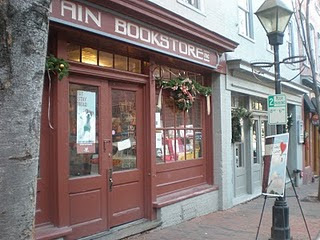
I’m the manager at Left Bank Books in St. Louis, Missouri, the largest full-line independent bookstore left in St. Louis, and it’s been around since 1969 – 40 years! That’s something to be proud of in this day and age, when so many independents are being forced to close their doors. The battles that indie bookstores are fighting are relentless, and in the current economic climate, more serious than ever. We struggle to survive amongst the monstrous corporate chains and the ultimate antagonist of our story – Amazon.
"It depends on why I'm snagged. Sometimes, I wrote myself into a dead end. That means I have to go back and fix whatever derailed the story. Sometimes I'm snagged because the particular scene is hard and I'm avoiding it. For that, I just have to get up the nerve and write it, however badly, and fix it later. Sometimes I'm snagged because I'm bored (exposition is my bane.) And for that, I just have to power through it and fix it later. Pretty much, no matter why I got stuck, the answer is brute force." - Saundra Mitchell, author of Shadowed Summer.
"Impatience, nervousness, exasperation...really any emotion without resorting to clichés like rolling the eyes or tapping a foot. There's so much we've been programmed, as readers, to expect as cues for emotions that it's sometimes tough to break out of that habit. Lazy writing and overused clichés are the bane of my existence! (...is "bane of my existence" an overused phrase? GAH!)" - Dawn Metcalf, author of Skin & Bones.
About the author: Kristina McBride, a former high-school English teacher and yearbook advisor, wrote The Tension of Opposites in response to the safe return of a child who was kidnapped while riding his bike to a friend’s house. She lives in Ohio with her husband and two young children. This is her first novel. Visit her online at http://www.kristinamcbride.com/.